ACARA Alignment: ACHEK020
Clip Length:2:09 minutes
Year: 2026
URL: https://www.youtube.com/shorts/O15wk9ALJaY
Economic Concepts: labour force participation, population growth rate, fertility rate
This short clip released in September 2026 highlights how Australia’s homegrown population growth has decreased from the high’s of the baby boomer years (3.5 kids per female) to now (less than 2.1 kids per female – replacement rate). Why does this matter? Who is going to care for all the aging Millennials in their golden years?
With all the debates going on from housing to migration recently this clip introduces population growth and includes a bunch of handy graphs and age pyramids. If you are looking at labour force participation rates and looking to tackle migration and the necessity of it for ongoing maintenance of Australia’s economy this clip can be a good way to start the conversation. Once you have shown this clip you could have a discussion posing the question:
“If we aren’t producing enough citizens to do the jobs that need doing, do we leave the jobs empty?”
After the discussion show students this age distribution graph and discuss how the average age profile has changed, ask students how they think this will change the workforce and also the types of products in demand.
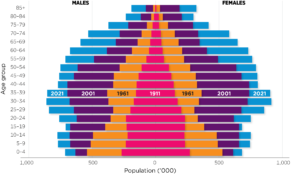
You could then move onto labour shortages and display https://www.jobsandskills.gov.au/data/occupation-shortage/occupation-shortage-list. As a group activity have a look and compare metropolitan to regional shortages. Randomly select a job and get students to raise their hand if they’d do the job. You can always ask one of the students with a raised hand to share with the class what attracts them to the job and maybe challenges some of their assumptions.